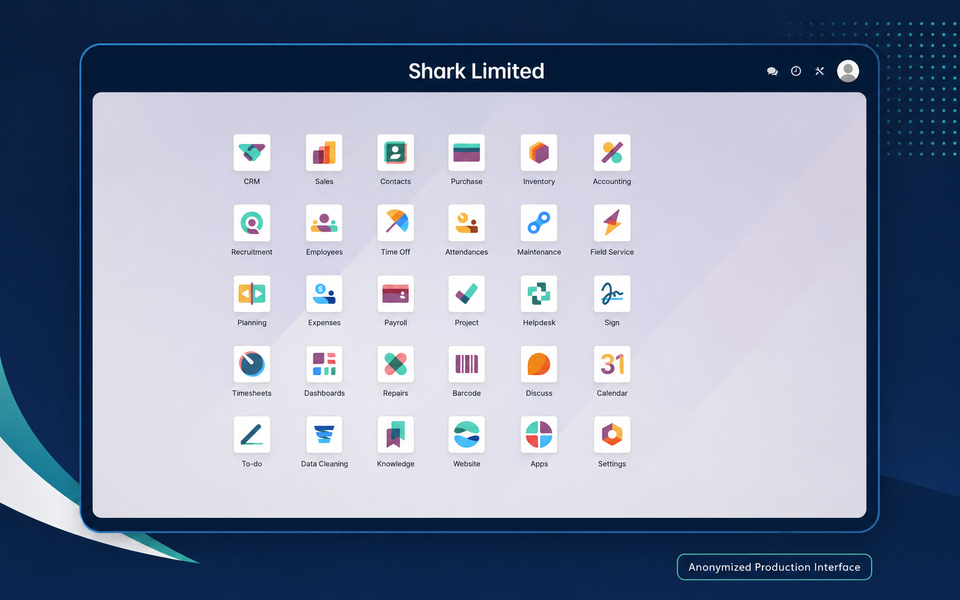
Chuti Group — Unified Multi-Company ERP Transformation
MindSynth built a unified multi-company ERP connecting Chuti Group’s CRM, resort-share sales, installments, member benefits, aftersales, HR, biometric attendance, payroll, procurement, inventory, employee assets, telephony and finance. The platform replaced fragmented coordination with controlled workflows, role-based approvals and one connected operational foundation across the group using Odoo Enterprise, Custom Odoo Modules, Multi-Company Architecture, Biometric Device Integration, Secure API Integration and Role-Based Portals.
Hospitality, Tourism, Resort-Share and Multi-Company Operations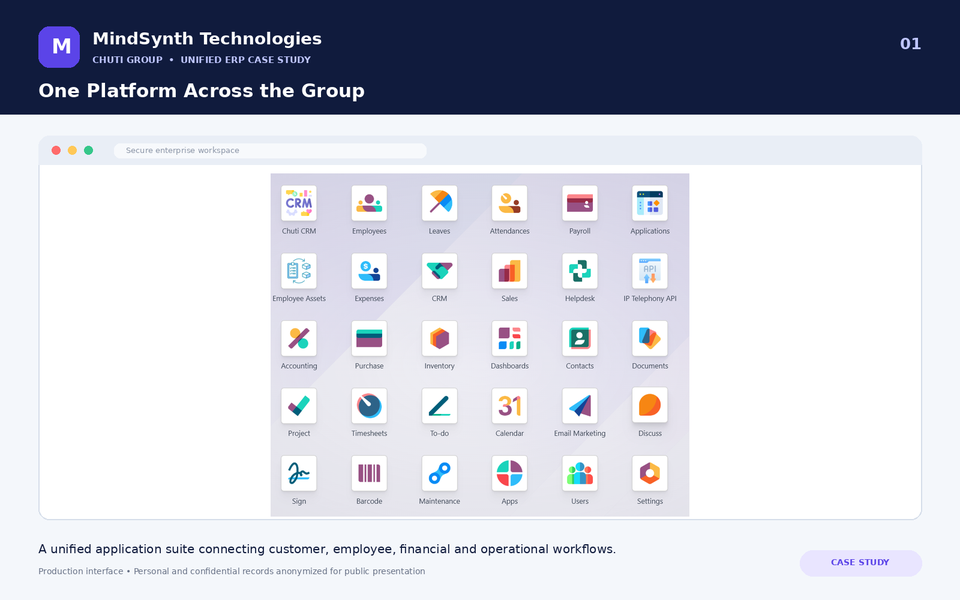
What We Built
Unified Multi-Company ERP
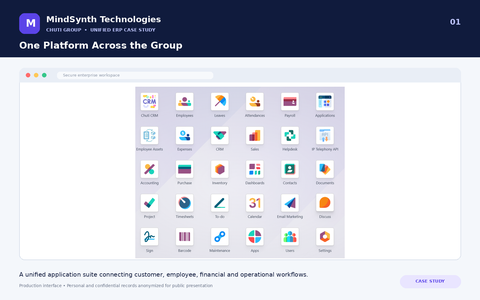
One connected Odoo Enterprise environment manages multiple Chuti Group concerns while preserving concern-specific access, operations, records and management visibility.
CRM and Controlled Share Sales
CRM, lead assignment, booking, sales, approval thresholds and a purpose-built resort-share allocation lifecycle connect customer acquisition with final handover.
Installments, Benefits and Aftersales
Installment schedules, collections, member entitlements, benefit consumption, aftersales tasks and customer communication are managed through connected workflows.
HR, Biometric Attendance and Payroll
Employee records, contracts, leave, biometric attendance, payroll, bonuses, employee requests and salary processing operate within a policy-driven HR environment.
Purchase, Inventory and Asset Custody
Procurement, warehouses, stock movements, opening-stock migration, employee asset allocation, transfer, return and custody history improve resource accountability.
IP Telephony and CRM Integration
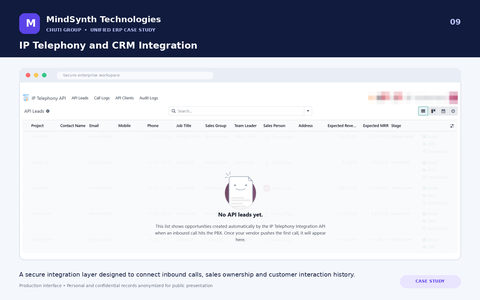
Secure APIs synchronize customer and sales-organization data while connecting call logs and interaction histories with the CRM.
Accounting and Financial Governance
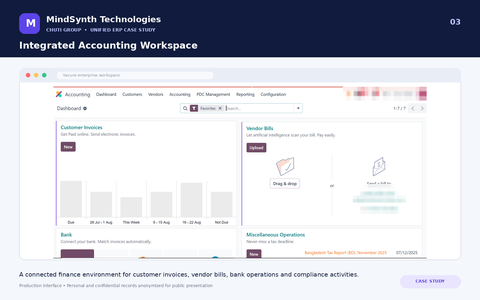
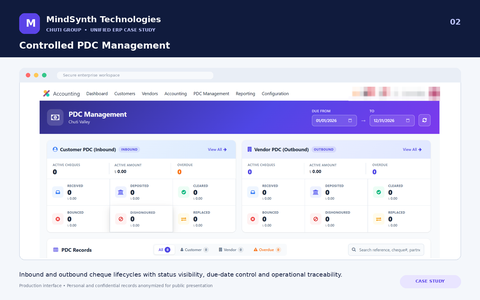
Payment claims, reconciliation, unidentified receipts, POS settlement, PDC, vendor advances, vouchers, assets and member-benefit costing form a controlled finance backbone.
Training and Continuous Enhancement
Phased UAT, role-based training, recorded sessions, manuals, operational SOPs, hypercare and ongoing improvements support sustainable adoption.
See It In Action
One Group. Multiple Concerns. One Connected ERP.
Chuti Group operates at the intersection of hospitality, tourism, resort development, membership and resort-share ownership, installment-based sales and long-term customer service.
Its operating model is significantly more complex than a conventional hotel, retail or property-sales business. A single customer journey can begin as a CRM lead and continue through booking, payment, controlled share allocation, installment collection, member-benefit entitlement, sales incentive, aftersales service and long-term account management.
At the same time, HR, attendance, payroll, procurement, inventory, employee assets, communication and finance must operate across multiple concerns of the group.
The requirement was therefore not simply to install several ERP modules. Chuti Group needed an umbrella platform capable of connecting its concerns, departments, approval structures and specialized business rules without losing operational flexibility.
MindSynth Technologies translated this requirement into a unified Odoo Enterprise ecosystem.
The Business Challenge
Chuti Group’s processes contained several interconnected challenges.
Resort shares and investment packages could not be handled like ordinary stock items. The organization needed to distinguish company-reserved shares from customer-sellable inventory and control how a share moved through booking, reservation, down-payment hold, full payment and final handover.
Member packages could include complimentary nights, resort discounts and other entitlements. These benefits needed to be allocated, consumed and tracked against the correct customer, package and project.
Sales also involved configurable minimum booking, down-payment and selling thresholds. Exceptional transactions required management approval instead of informal overrides.
Installment collection, overdue follow-up, payment receipts, commissions, aftersales tasks and customer communications all depended on the original booking. Managing these activities through disconnected processes would make it difficult to maintain a reliable view of the customer relationship.
Internally, Chuti Group also required:
- Multi-company employee management
- Contract-specific employment policies
- Biometric and location-aware attendance
- Customized payroll and bank-sheet preparation
- Employee self-service requests
- Procurement and inventory control
- Employee asset custody
- Inter-company employee transfers
- Customer-call visibility
- Controlled accounting and reconciliation
- Management reporting and audit trails
The central challenge was to make these processes work as one connected operational lifecycle.
Requirements Elicitation and Operational Discovery
MindSynth began with structured discussions involving management and representatives from sales, CRM, aftersales, HR, administration, procurement, inventory, finance and other operational functions.
The analysis went beyond recording requested features. Existing activities, approval paths, business policies, exception scenarios and cross-department dependencies were examined to understand how work was actually performed.
The discovery process included:
- Stakeholder meetings and requirement workshops
- Existing-process and target-process analysis
- Review of operational documents and working records
- Role and access-right identification
- Approval and exception mapping
- Business-rule validation
- Data and reporting requirement analysis
- Demonstrations and stakeholder feedback
- Fit-gap analysis against standard Odoo Enterprise
- Prioritization of configuration and customization needs
Standard Odoo capabilities were selected wherever they matched the requirement. Custom extensions were designed only where Chuti Group’s resort-share, member-benefit, installment, approval or multi-company workflows could not be represented adequately through standard configuration.
This approach produced a solution aligned with the business rather than forcing the business to follow a generic software process.
A Unified Multi-Company Architecture
The ERP was structured as an umbrella platform for Chuti Group’s concerns.
Authorized users can work within the appropriate company or concern while management receives consolidated operational visibility. Company-specific records, warehouses, employees, attendance devices, approvals and transactions remain controlled through roles and access rights.
The architecture provides a common foundation for shared processes while allowing each concern to maintain the operational separation it requires.
This reduces repeated system administration, fragmented master data and inconsistent departmental practices.
Connecting CRM with the Complete Customer Lifecycle
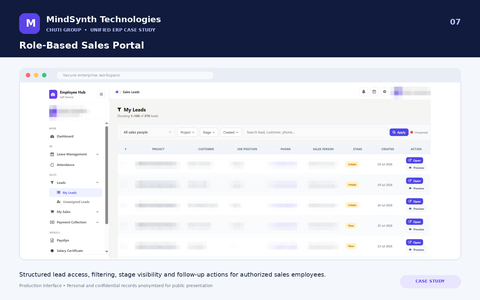
The CRM environment was configured and extended to manage leads originating from different channels, including organizational campaigns, digital sources and salespersons’ own networks.
The solution supports:
- Lead creation and assignment
- Sales teams, groups and salesperson structures
- Lead scoring and prioritization
- Opportunity pipelines and stages
- Calls, meetings, emails and follow-up activities
- Communication-history tracking
- Lead-to-booking and quotation conversion
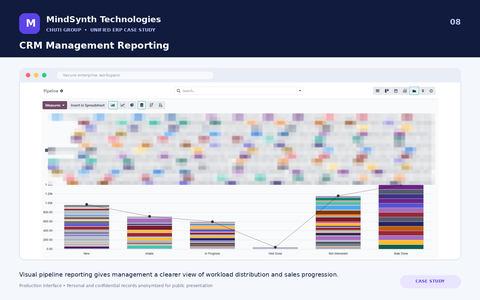
- Sales and opportunity reporting
- Fund-collection visibility
- Project and unit sales monitoring
Instead of ending at quotation generation, CRM information remains connected with booking, installment, allocation, commission and aftersales activities.
This gives authorized employees a clearer understanding of the customer’s position and reduces repeated information collection between departments.
Purpose-Built Resort-Share and Package Management
One of the most important customizations was the controlled resort-share lifecycle.
The platform distinguishes between shares reserved for the company and shares available for customer sale. A share progresses through controlled operational states:
Available → Reserved → Down-Payment Hold → Fully Paid → Handed Over
A booking temporarily reserves the required quantity. When the qualifying down payment is received, the share enters a controlled hold state. It is not treated as finally handed over or permanently deducted merely because a booking has been created.
Final allocation is completed only after the required payment and handover conditions have been satisfied.
This design protects the organization against overselling, premature allocation and unclear inventory commitments.
The workflow also supports management-controlled exceptions when booking, down-payment or selling values fall below approved thresholds. Rather than bypassing policy, the transaction enters an approval process with a traceable decision history.
Installments, Member Benefits and Aftersales
Booking forms are connected with installment plans, payment progress, deadlines and collection activities.
The solution supports:
- Installment schedule generation
- Collection and payment-history tracking
- Due and overdue installment visibility
- Payment receipts and supporting records
- Customer follow-up activities
- Project-specific aftersales tasks
- Deadlines, alerts and responsibility assignment
- Customer communication history
- Installment and collection analysis
- Member and shareholder benefit allocation
- Benefit eligibility and consumption tracking
- Package-specific complimentary nights and discounts
Customer and membership portal capabilities provide controlled access to relevant booking information, payment history, installment progress, receipts, benefits, nominee information and contractual records.
This connects the initial sale with the long-term member relationship instead of treating them as separate business processes.
HR, Attendance and Payroll Automation
The HR platform was designed around Chuti Group’s organizational structure and employment policies.
Its capabilities include:
- Multi-company employee profiles
- Department and reporting-hierarchy management
- Employee documents and private HR information
- Contract creation and lifecycle management
- Employment-type and work-schedule configuration
- Leave types, allocation rules and approval levels
- Employee attendance analysis
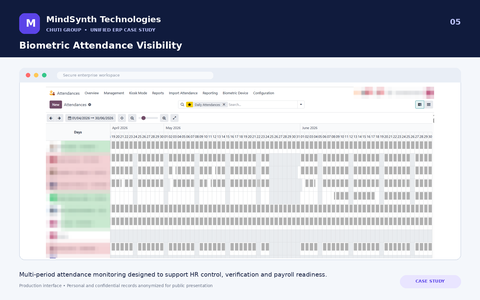
- Biometric attendance integration
- GPS and IP-aware field attendance
- Manual attendance with approval
- Overtime and extra-hours validation
- Customized payroll structures
- Allowances, deductions and formula-based salary rules
- Tax, provident-fund and gratuity handling
- Batch payroll generation
- Salary sheets, payslips and bank-transfer sheets
- Bonus processing
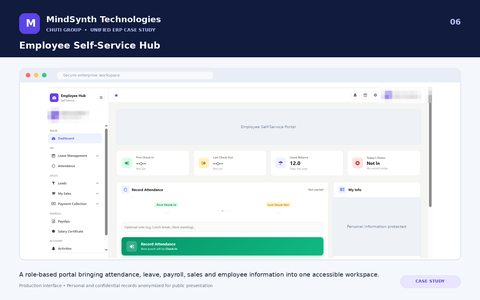
- Employee requests for leave, NOC and salary statements
- Payroll, leave and request history through employee self-service
The employee portal gives users access to appropriate HR and operational services without exposing unnecessary back-office functionality.
Making Biometric Attendance Operationally Resilient
Chuti Group uses multiple biometric devices across different locations and floors. In real operating conditions, older devices, network interruptions and unstable connectivity can occasionally disrupt automated synchronization.
MindSynth addressed this as an operational issue rather than merely a technical exception.
In addition to device integration, a controlled manual attendance-pulling process and detailed Standard Operating Procedure were prepared for authorized HR and administrative users.
The guide covers:
- Correct concern and device selection
- Connection testing
- Attendance-data downloading
- Device-by-device synchronization
- Report verification
- Recommended daily pulling schedules
- Troubleshooting procedures
- User responsibilities
- Audit-oriented completion checklists
This provides a reliable fallback process and helps protect attendance, payroll and management reporting from device or connectivity problems.
Procurement, Inventory and Employee Custody
Following the core implementation, the platform was expanded to cover procurement, inventory and internal resource control.
The extended scope includes:
- Vendor and product-master management
- Request for Quotation and Purchase Order workflows
- Purchase approvals
- Goods receipts
- Warehouse and location configuration
- Internal stock transfers
- Inventory availability and movement reporting
- Product and opening-stock import
- Supplier-billing linkage
- Role-based procurement and store access
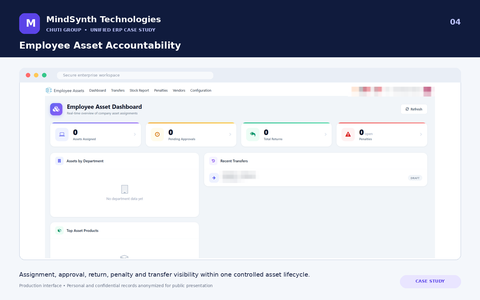
A customized Employee Custody workflow manages organizational assets issued to employees.
Assets can be requested, approved, allocated, transferred and returned while maintaining the complete custody history. The solution also supports asset condition, lost or damaged status, maintenance requirements and accountability reporting.
Inter-company employee transfer capabilities allow employee information and relevant records to move between Chuti Group concerns through a controlled workflow and audit trail.
Connecting IP Telephony with the CRM
The ERP ecosystem was further enhanced through an IP telephony integration layer.
Secure APIs connect the telephony environment with customer and sales-organization records, including sales groups, teams, salespersons and telephone extensions.
Call information can be associated with the relevant customer and responsible salesperson. The integration captures details such as:
- Incoming or outgoing direction
- Caller and recipient numbers
- Call date and time
- Duration
- Agent or extension
- Call status or disposition
- Customer association
- Recording reference, where applicable
Authentication, authorization, audit logging, duplicate-prevention rules and structured API documentation support secure and maintainable integration.
This gives sales and service users a more complete customer-interaction history inside the ERP rather than leaving important conversations isolated within the telephony system.
Building the Accounting and Finance Backbone
As the ERP matured, the finance workstream was connected with the existing CRM, sales, booking, installment, procurement and member-management operations.
The finance solution addresses the practical realities of customer and vendor transactions, including:
- Customer payment claims with supporting evidence
- Verification by Finance and Accounts
- Unclaimed or unidentified receipt management
- Bank, cash, EFT and mobile-financial-service collections
- Card POS pending settlement and bank-charge tracking
- Post-dated cheque receivable and payable lifecycles
- Cheque maturity, clearing, dishonour and re-presentation
- Work-order advances
- Departmental and audit bill deductions
- Vendor-bill and payment traceability
- Receipt, payment, journal and contra vouchers
- Debit notes, credit notes and reversals
- Asset registration and depreciation
- Member and shareholder benefit-cost tracking
- Corporate customer credit terms
- Role segregation, approvals and audit trails
- Operational and management dashboards
A key example is unidentified customer payment. When money appears in a bank, POS or MFS record without sufficient customer information, it can remain under a controlled unclaimed-receipt workflow. When the customer later submits proof, Finance can verify and adjust it against the correct booking, installment or account without losing the original transaction history.
This is substantially more controlled than treating every visible deposit as an immediately identified customer payment.
Phased and Iterative Implementation
The initial implementation followed six planned phases:
- Odoo Enterprise deployment and core configuration
- Human Resource Management customization
- Product, inventory and installment management
- Employee portal customization
- Aftersales and membership portal implementation
- Final User Acceptance Testing and necessary refinements
Each phase included configuration, required development, demonstrations, testing, stakeholder feedback and operational validation.
The implementation was not treated as a one-time software handover. Feedback from actual usage informed later enhancements such as expanded purchase and inventory control, employee custody, inter-company transfers, biometric operating procedures, telephony integration and deeper financial governance.
This iterative delivery model allowed the platform to grow with Chuti Group’s policies and operational maturity.
Training, Documentation and User Adoption
A technically capable system delivers limited value if users cannot apply it confidently.
MindSynth therefore combined implementation with role-based learning and adoption support.
The engagement included:
- Onsite and remote training
- Staging-environment practice
- Role-specific demonstrations
- Practical transaction scenarios
- Recorded training sessions
- User manuals and operating guides
- UAT scenarios and issue tracking
- Go-live checklists
- Hypercare after deployment
- Troubleshooting support
- Follow-up training where required
Training explained both system operation and the business reason behind each workflow. This helped users understand not only what action to perform, but also how that action affected another department or the broader customer lifecycle.
Operational Impact
The unified platform has created several important operational improvements for Chuti Group:
- Multiple concerns can operate within one controlled ERP ecosystem.
- CRM, booking, installments, allocation, benefits and aftersales are connected.
- Resort-share availability and final allocation follow clearly defined states.
- Management exceptions are approval-driven and traceable.
- Customer payment and installment information is easier for authorized users to access.
- HR policies can be applied more consistently across employee operations.
- Biometric attendance is connected with reporting and payroll requirements.
- Procurement, inventory and employee assets have clearer accountability.
- Call interactions can become part of the customer’s CRM history.
- Finance receives stronger controls for reconciliation, PDC, settlements, advances and vouchers.
- Self-service portals reduce routine administrative dependency on back-office users.
- Recorded training, manuals and SOPs preserve organizational knowledge.
- New requirements can be added to the same platform without creating another disconnected system.
The return on the ERP investment comes from the combination of these improvements: less repeated data handling, fewer departmental handoffs, better exception control, improved accountability and the reuse of one technology platform across multiple operational concerns.
Continuous Support and Product Enhancement
MindSynth’s relationship with Chuti Group continued beyond the original go-live.
Operational feedback, new policies, user observations and emerging management requirements were reviewed and converted into controlled enhancements. New capabilities were integrated into the existing ecosystem instead of being developed as isolated applications.
This continuous-improvement model helps ensure that the ERP remains aligned with the organization as its concerns, users and operational requirements evolve.
More Than an ERP Installation
The Chuti Group engagement demonstrates MindSynth Technologies’ ability to understand an unconventional and highly interconnected business model.
The resulting solution combines elements of:
- Hospitality operations
- Resort-share and project-based sales
- Installment collection
- Member entitlement management
- Aftersales service
- Multi-company HR and payroll
- Procurement and inventory
- Employee asset accountability
- Customer communication
- Finance and accounting governance
It is not simply a collection of Odoo modules. It is a unified operational platform shaped around real business rules, real exceptions and real users.
Through requirements engineering, fit-gap analysis, multi-company architecture, controlled customization, iterative delivery, extensive training and continuous enhancement, MindSynth helped Chuti Group establish a more structured, transparent and scalable digital foundation.
Want results like Chuti Group — Unified Multi-Company ERP Transformation?
Tell us about your business and we'll get back with a tailored quote.
Other Case Studies